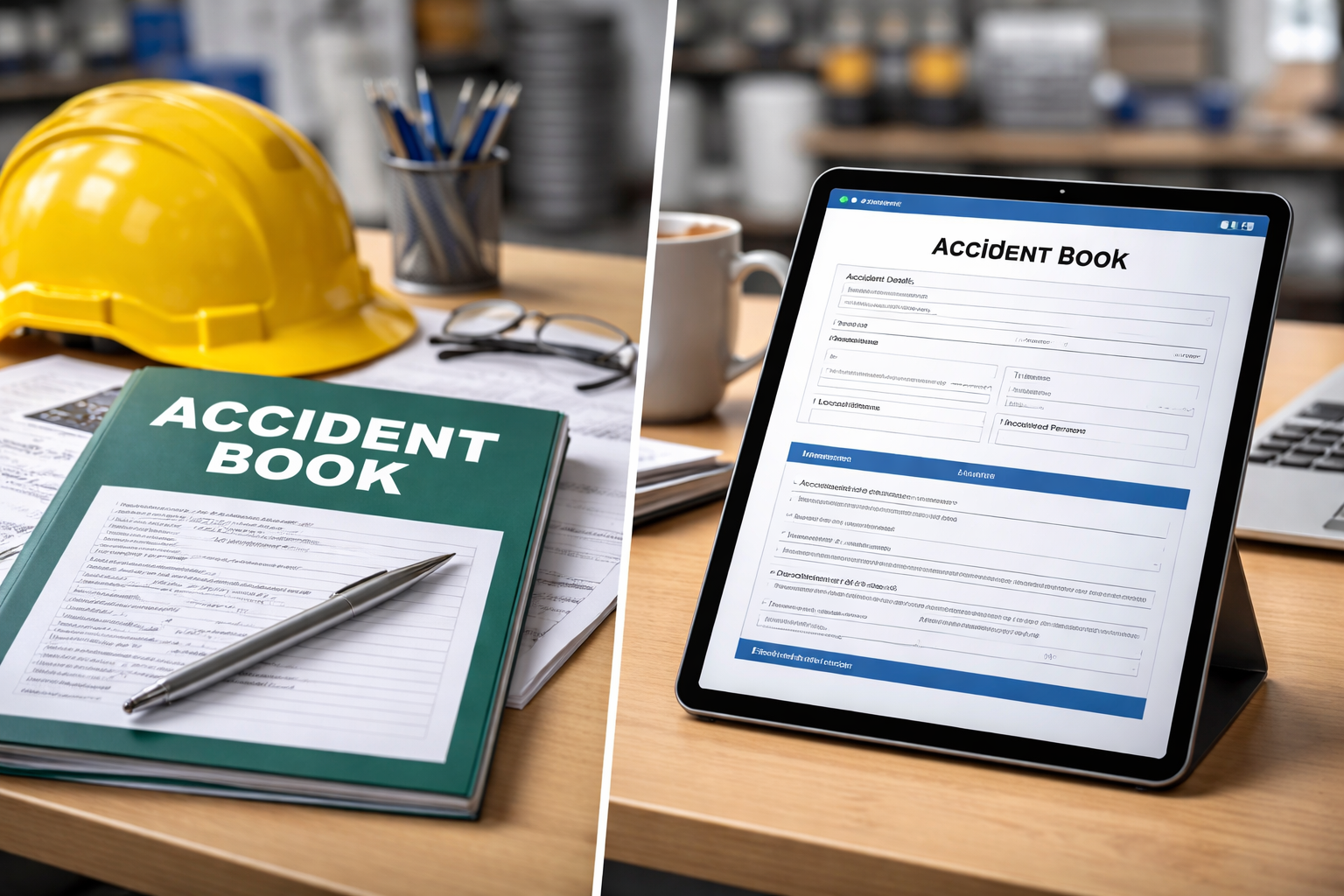
For decades, the accident book has been a simple fixture in workplaces across the UK. A physical book kept in an office drawer, first aid room, or site cabin, used to record injuries when they happen.
For many businesses, that system has barely changed. When an accident occurs, someone finds the book, writes down the details, and the record is filed away.
But workplaces themselves have changed. Companies now operate across multiple locations, managers move between sites, and compliance expectations around data protection and incident reporting have increased. As a result, many employers are now questioning whether the traditional paper accident book is still the best way to manage accident records.
Understanding the differences between paper and digital accident books helps employers decide which approach genuinely supports compliance, safety management, and operational control.
The role of an accident book
Before comparing formats, it is important to understand what an accident book is designed to achieve.
An accident book provides a structured way to record workplace injuries and incidents. It captures the essential facts of what happened, when it occurred, who was involved, and what action was taken. These records serve several purposes. They help employers track patterns of incidents, provide evidence if insurance claims arise, and demonstrate that health and safety obligations are being taken seriously.
The legal framework for accident recording sits within broader workplace safety law overseen by the Health and Safety Executive. While the law requires incidents to be recorded in certain circumstances, it does not prescribe the exact format those records must take. In other words, both paper and digital accident books can meet legal expectations when used properly.
The real question is not whether one is lawful and the other is not. The question is how effectively each system supports accurate, accessible, and reliable records.
How paper accident books work in practice
Paper accident books remain extremely common, particularly in smaller workplaces. The format is familiar and simple. When an incident occurs, the details are written directly into the book, usually by a manager, supervisor, or first aider.
The simplicity of the paper system is one of its strengths. It requires no technology, no login credentials, and no training beyond basic awareness. Anyone with access to the book can record an incident immediately.
However, paper systems also introduce limitations that often become visible only when records are needed later. Accident books may be kept in a single location, meaning incidents must be reported back to that location before they are recorded. If multiple sites operate independently, each may keep its own book, creating fragmented records across the organisation.
Physical books are also vulnerable to being misplaced, damaged, or lost. When records are needed for inspections, claims, or internal investigations months or years later, retrieving them can become difficult.
How digital accident books work
A digital accident book performs the same core function as a paper one but stores records electronically rather than physically.
Instead of writing details into a notebook, incidents are entered into an online system or software platform. The system stores the record securely and makes it accessible to authorised personnel when needed.
Digital systems often allow incidents to be recorded from multiple locations, whether through a computer, tablet, or mobile device. This means that incidents can be documented immediately at the site where they occur, rather than waiting for access to a physical book.
Because the information is stored centrally, employers can review incidents across multiple sites, identify trends, and ensure records are not isolated within individual locations.
Compliance and legal considerations
One of the most common concerns employers raise about digital systems is whether they are legally acceptable.
UK health and safety law focuses on the existence of accurate records, not the medium in which they are stored. As long as accident records are accurate, secure, and accessible when required, a digital accident book can meet the same legal expectations as a paper one.
Data protection also plays a role. Accident records often contain personal and health-related information. Employers must ensure that such data is handled appropriately in line with UK GDPR requirements overseen by the Information Commissioner's Office. Digital systems can support compliance through controlled access, secure storage, and clear audit trails showing when records were created or amended.
Paper systems can also comply with these requirements, but doing so relies heavily on physical control over who can see and handle the book.
Record accuracy and transparency
Another key difference between paper and digital systems lies in how records evolve over time.
With paper books, correcting an entry can be awkward. Changes may involve handwritten notes, corrections, or annotations. While these approaches can be legitimate when done transparently, they sometimes make records difficult to interpret later.
Digital systems often record changes automatically. If an entry is amended, the system can show when the change occurred, who made it, and what was altered. This creates a clear audit trail that helps preserve the credibility of the record.
In environments where accidents may lead to insurance claims or regulatory scrutiny, that traceability can be valuable.
Managing accident records across multiple sites
For organisations operating from more than one location, the limitations of paper accident books become more pronounced.
Each site may maintain its own book, meaning incidents are recorded locally but rarely reviewed collectively. Patterns that emerge across different sites can go unnoticed simply because the records are stored in separate places.
Digital accident books allow records to be stored centrally while still allowing each site to record incidents independently. This makes it easier for management teams to see the broader picture and respond proactively to emerging risks.
Accessibility during inspections and investigations
When an inspection or investigation takes place, access to accident records becomes critical.
If records are stored in paper books across multiple sites, gathering them can take time. Books may need to be retrieved from archives, transported between locations, or reviewed manually to locate relevant entries.
Digital systems allow authorised users to access records immediately from a central system. This can make it significantly easier to respond to enquiries from inspectors, insurers, or internal investigators.
The practical decision for employers
Both paper and digital accident books can fulfil the basic requirement of recording incidents. For small workplaces with a single location and straightforward operations, a paper book may continue to function adequately.
However, as organisations grow, operate across multiple sites, or face increasing expectations around data protection and record management, the limitations of paper systems become more apparent.
Digital accident books are not simply about replacing a notebook with software. They change how accident records are stored, accessed, and analysed across the organisation.
Key takeaway
The choice between a digital accident book and a paper one is less about legality and more about practicality.
Paper systems are familiar and simple but rely on physical control and manual processes. Digital systems provide centralised records, improved traceability, and easier access across multiple locations.
For many modern workplaces, the question is no longer whether a digital accident book is acceptable. It is whether a paper-based system still provides the control and visibility that employers need.